Building The Perfect Cue For You
For many players, a first "real" pool cue is just the beginning. As your skills grow, you’ll start to realize that a cue isn’t a static object—it’s a precision tool that can be tuned, tweaked, and accessorized to fit your specific stroke.
Whether you want more spin, a better grip, or a more comfortable reach, here are the most effective ways to upgrade your cue, explained for the everyday player.
Cue Parts | Tuning the "Feel"
These changes happen under the hood or at the points of contact. They directly affect how the cue moves through your hand and strikes the ball.
Custom Shaft Diameters
Most standard cues come with a 12.75mm to 13mm shaft.
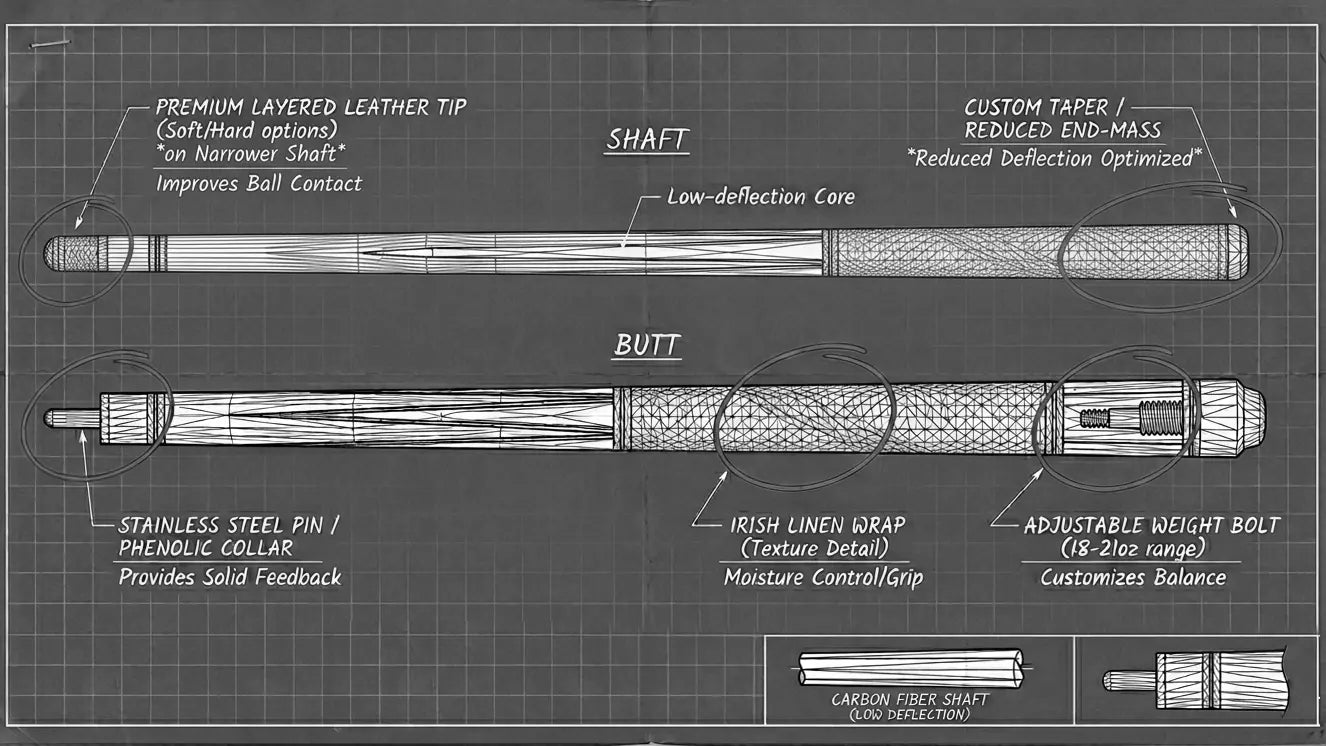
- Why upgrade? Serious players often "taper down" to an 11.75mm or 12.25mm shaft. A thinner shaft has less "end mass," which reduces deflection (when the cue ball squirts off-line during a spin shot). It also allows you to see more of the cue ball, making precision shots easier.
- What to look for: If you’re a beginner, stay near 12.75mm—it’s more forgiving. Move smaller only when your accuracy is consistent.
The Tip: Important And Often Ignored
The pool cue tip is the only part of the cue that actually touches the ball.
- Soft Tips: Provide more "grip" on the ball, making it easier to apply English (spin). However, they flatten out (mushroom) faster and need more maintenance.
- Hard Tips: Last longer and stay in shape, but they require better technique to avoid miscues.
- Why upgrade? Switching from a stock tip to a premium layered leather tip (like a Kamui or Tiger) can instantly improve the "feedback" you feel in your hand.
Wraps (The Grip)
If your hand is slipping or getting sweaty during long sessions, your wrap is the problem.
- Irish Linen: The classic choice. It’s a pressed thread that absorbs moisture and provides a textured, reliable grip.
- Leather: Offers a premium, smooth feel and lasts a lifetime. It doesn’t absorb as much moisture as linen but provides a very stable "tackiness".
- Sport Wrap: When performance matters most. It provides the best grip and has extra padding to absorb vibrations from breaking and other hard shots.
- No-Wrap: Some players prefer the feel of the raw wood (or fiberglass) for total feedback.
Weight Bolts
Most cues have a hollow cavity in the butt where a weighted bolt is screwed in.
- Why upgrade? You might find your 19oz cue feels a bit light for powerful breaks, or your 21oz cue feels "clunky" for delicate shots. By swapping out a weight bolt, you can change the cue’s weight in half-ounce increments to find your "sweet spot".
External Add-ons: Expanding Your Arsenal
These are the parts you add to the outside of the cue or keep in your case to solve specific problems on the table.
Performance Shafts (Carbon Fiber vs. Wood)
If you really want to change your game, you don't buy a new cue—you buy a new shaft.
- Carbon Fiber: These are the "supercars" of the pool world. They are virtually warp-proof, incredibly smooth, and offer the lowest deflection possible. Low-Deflection
- Wood: These use hollow-front technology or multi-piece construction (like the Jacoby Ultra) to give you the benefits of low deflection while keeping the traditional wood feel.
Cue Extensions
We've all had that shot where the cue ball is just out of reach, forcing you to stretch awkwardly over the table.
- Why add it? A cue extension screws into the back of your cue (replacing the rubber bumper) to give you an extra 4 to 12 inches of reach. It’s much more stable than using a bridge stick.
Joint Protectors
These are simple screw-on caps for the joint of your cue.
- Why add them? They protect the delicate threads of your joint and the wooden "face" of the cue from getting dinged or collecting dirt in your case. They are the cheapest insurance you can buy for your equipment.
Slip-on Bridges (The Moosehead)
While most pool halls have a "rake" (bridge stick), they are often beat up or have missing plastic heads.
- Why add it? A small, portable bridge head (like a "Moosehead") can slide onto the end of any house cue, instantly giving you a stable, high-quality bridge for those hard-to-reach shots.
Summary: Where to Start?
If you're looking for the biggest "bang for your buck," start with a premium tip upgrade. It’s the least expensive change but has the biggest impact on how the ball reacts. From there, look into joint protectors to keep your gear safe, and eventually, experiment with weight bolts to find the balance that feels like a natural extension of your arm.